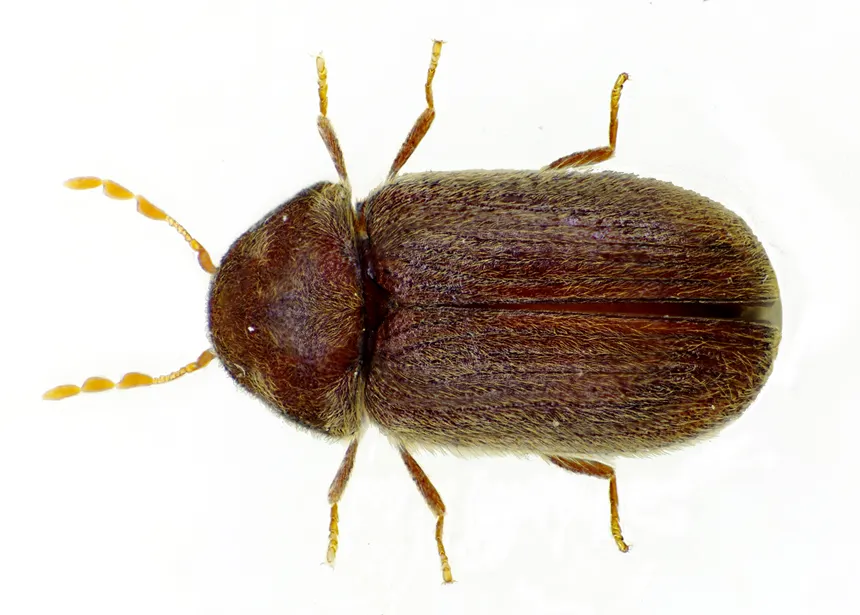
Lasioderma serricorne, the dry tobacco beetle or louse
Lasioderma serricorne, the dry tobacco beetle or louse
Morphological characteristics: The aculeus, body length 2.5-3.5mm, oval in plan view, brown or reddish-brown in colour. The head type is hypogonate, the antennae are serricorne and the elytra are unlined and covered with a thin, blond fuzz. The larva, 3,5 mm long, is white to pale yellow, stout, convex with fine hairs. Head and legs are sub-brown.
Biological cycle: found to have 3 generations per year in Northern Greece. Depending on the climate and the food it finds, it can have several generations per year. It disperses as a larvae in the tobacco bundles. The larva eats the tobacco at the bottom of the bundles but the larva may feed similarly. Its natural enemies are the hymenoptera Lariophagus distinguendus and the mite Tyrophagus putrescentiae. Infestation: Together with Ephestia elutella they are the main pests of stored tobacco. It has a wide variety of food preferences: cigarettes, cigars, cacao, chocolate, spices, pasta, aromatic plants in collections, dry hoofs, oily seeds and placentas, carob, legumes, native plants in the open air, etc.
The systematic classification of Lasioderma serricorne F